
What we do
We raise sunken concrete back to where it should be. Driveways. Patios. Garage floors. Basement slabs. Sidewalks that became trip hazards. The technical name is mudjacking. We pump a slurry of water and sandy loam soil under the slab through 1-1/2" holes, the slurry fills the void, the slab lifts back to grade, and the holes get patched flush with concrete.
No demolition, no haul-off, no new concrete curing to a different color than the rest of your slab. Timing depends on the job, and Trevor covers it at the estimate.
How we work
Trevor quotes every job in person. Free. He walks the slab with you, measures the drop, checks the drainage, and tells you what to fix and what to leave alone. You get a written estimate, and the price on it doesn't change unless you ask for work that wasn't on the original.
The lift gets its own scheduled day, and Trevor sets that schedule with you at the estimate.
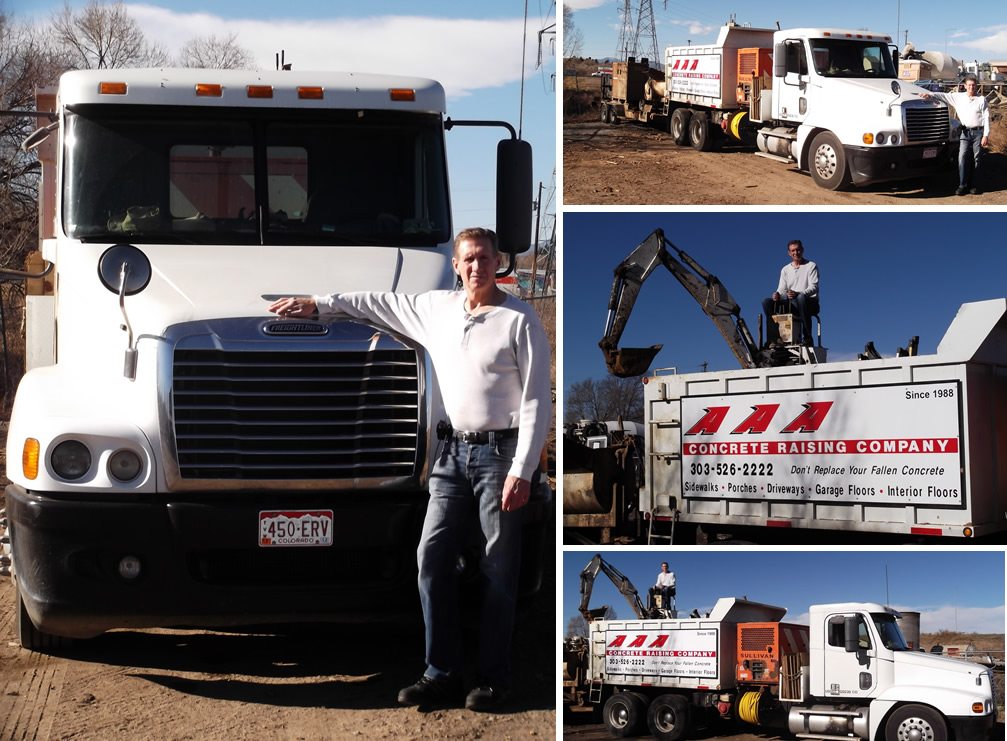
The truck
Our truck carries up to 10 yards of material. That's about two times what other contractors bring. The reason matters: when a crew runs out of slurry mid-lift, the slab settles unevenly while they leave to refill. We don't run out. We finish the job in one sitting.
The pump is the other half of the story. Ours is portable, with a short hose, brought right to the slab. Contractors who park at the street and pump through a long hose are stuck with whatever thin mix will survive the trip. We batch the slurry at the slab, to the thickness your job needs, and fill every void.
The mix
Water and sandy loam soil. That's it. No foam chemicals, no proprietary polymers, no two-part anything. The exact mix changes job to job because soil and slabs change job to job. Once the slurry cures, it's hard, heavy fill, far heavier than foam, which is exactly what you want under a slab in Front Range soil.
The Front Range factor
Colorado clay swells when it's wet and shrinks when it dries. The dry side is what kills slabs. A dry summer pulls moisture out of the soil under your driveway, the soil contracts, and the slab follows the void down. Then a wet spring rehydrates the clay, the soil expands, but it doesn't push the slab back up. It pushes around it. After a few cycles you've got a slab sitting an inch or two below where it started.
The fix isn't replacing the slab. The fix is filling the void with something the soil can't shrink away from. Mudjacking does that. The cured slurry doesn't wash out or shrink the way loose fill does, so a lift done right stops fighting the soil that caused it.
Who we serve
We work the greater Denver metro: Denver, Aurora, Arvada, Lakewood, Golden, Wheat Ridge, Westminster, and Thornton. Not sure whether we reach you? Call and ask.
Most of our customers are homeowners. We also do commercial work for property owners, managers, and HOAs across the metro.
Why we don't do foam
Foam is fine. It's the right tool for some jobs: thin slabs, indoor work, very tight access. We don't use it because for the work we do, the math says concrete every time. Heavier fill holds better in clay, and the long-term hold is what matters under a slab that carries your car.
If a contractor pushes foam for an exterior driveway in Colorado clay, ask them how the whole cavity gets filled. Grouting experts have documented foam lifts that expanded into pedestals at the drill holes and left much of the area underneath untreated. That's not the same as a stabilized slab.