


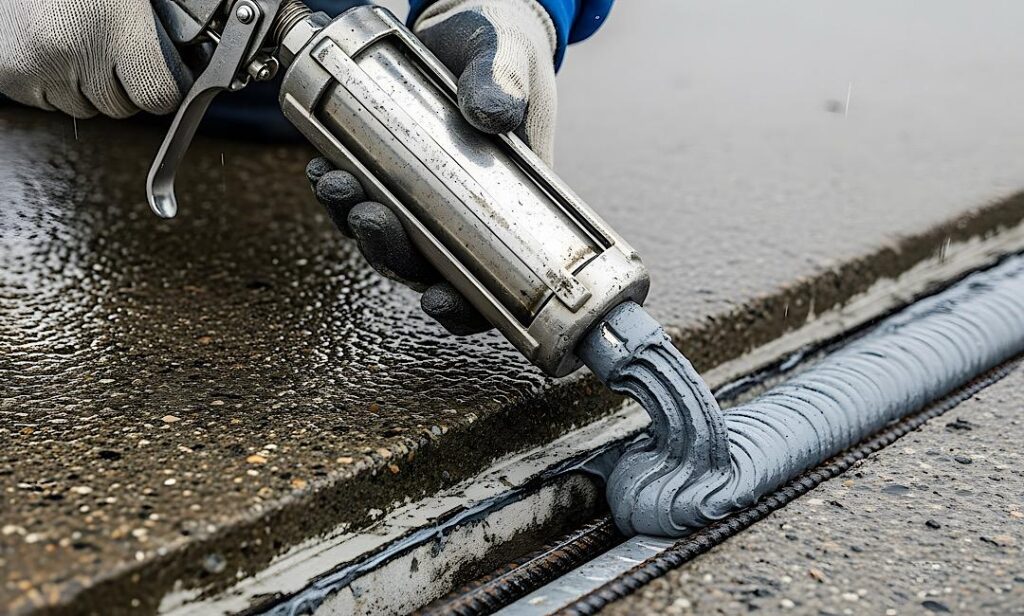
Keep water out. Keep edges from breaking down. Keep your slabs looking intentional.
This guide explains concrete expansion joint caulking in plain terms: what joints need sealant (and which don’t), how the “backer rod + sealant” system works, and how to avoid the common mistakes that cause early failure—especially in Denver, Colorado.
Expansion joints vs. control joints (why caulking decisions differ)
Practical rule of thumb in Denver: joints that can funnel water under the slab (especially along the house, steps, garage edges, or where slabs meet) are strong candidates for proper sealing. The goal is moisture management and edge protection—not just “making it look nicer.”
Why joint caulking matters more in Denver’s freeze-thaw conditions
Sealing doesn’t “stop” concrete movement—nothing should—but it can help reduce water intrusion that accelerates soil loss (voids), slab settlement, and joint deterioration.
The system that works: clean joint + backer rod + properly shaped sealant
- Clean, dry surfaces so the sealant can bond to the concrete (dust and dampness are frequent failure points).
- Backer rod to control sealant depth and help the sealant stretch correctly as the joint moves.
- Two-sided adhesion (bond to the joint sidewalls, not the bottom) so the sealant can flex instead of tearing prematurely.
Quick sizing guide (homeowner-friendly)
- Pick the right backer rod diameter: slightly larger than the joint width so it fits snugly and stays in place.
- Don’t overfill: the sealant should form a smooth, slightly concave profile across the top (think “bridge,” not “plug”).
- Depth matters: too deep wastes material and can limit movement; too shallow can reduce durability.
Step-by-step: How to caulk a concrete expansion joint (the pro-style workflow)
1) Decide if you’re sealing the right joint
2) Remove failed material and clean the joint
Tip: If you rinse the joint, give it enough dry time. In Denver’s spring and fall, shaded areas can stay damp longer than you think.
3) Set backer rod to the correct depth
If the joint is too shallow for backer rod, a bond-break approach may be used to prevent three-sided adhesion (follow product instructions).
4) Apply sealant with control (and don’t chase perfection)
For appearance, painter’s tape along both sides can help keep edges crisp—especially helpful if you’re detail-focused or working on a high-visibility patio or front walk.
5) Tool it correctly and protect cure time
Quick “Did you know?” facts
- Most joint sealant failures trace back to surface prep (dusty concrete) or joint design (wrong depth/three-sided adhesion)—not “bad caulk.”
- Edges deteriorate faster when water and grit sit in the joint; keeping joints sealed can reduce that gritty “sandpaper” effect on the concrete arris (edge).
- If you’re seeing repeating settlement along a joint line, that can indicate base washout/voids—a structural issue that sealing alone won’t fix.
Denver-specific tips (freeze-thaw, de-icers, and drainage)
Plan around weather, not just your schedule
Treat the symptom and the cause
Watch de-icing habits near joints
When caulking isn’t enough: signs you may need lifting or void fill first
- One slab edge has dropped and created a trip hazard (common on sidewalks and patios).
- Gaps keep reopening even after sealing.
- Water consistently runs into the joint and disappears beneath the slab.
- Cracks are spreading because the slab is rocking or unsupported.